|
RESTORING AN ICON
Rusty parts to racing car
Part 2 - An engine for the Connew |
It was all very nice having the car - some of the car - now sufficiently rebuilt for people to see but obviously we would not be able to make further progress on the back half of the car without a fairly important item; an engine. Although all the rear suspension of the car was attached to the gearbox, even if we had had a gearbox, without an engine, nothing could be connected. Through the Nostagia Forum I was contacted by a man named Steve Holter who told me a very interesting story....
Many years earlier, the Ford Motor Company had decided that they wanted to insert full-sized copies of their hugely successful Cosworth DFV engine in car museums all over the world. They entrusted the task of producing these copies to a gentleman named Paul Foulkes-Halbard. who lived near Polegate in Sussex. Initially, Mr. F-H had two sets of aluminium castings copied from a real engine and subject to Ford approval, a further large number of sets would be produced. One set of castings was bolted together, looking for all the world like a real engine and it was taken to a board meeting of Ford executives, whereupon the idea was scrapped and no more castings were made.
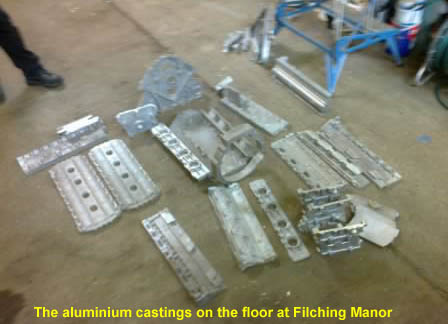 In the grounds of the Foulkes-Halbard home, which is called Filching Manor, a museum has been created which contains many items connected with the Campbell speed record family - Malcolm and Donald. Paul Foulkes-Halbard died in 2003 but his son Karl has since taken over the running of the museum. At some point in time, the aforementioned Steve Holter worked at the museum, helping to restore one of the Bluebird water speed record boats and he became aware that the second set of DFV castings was still around. They were casually discarded and had found a home in a chicken shed. Steve very kindly put us in touch with Karl Foulkes-Halbard who said that if we were prepared to come and get them, we were welcome to take them away at zero cost to ourselves. All these arrangements were made just before the 2014 Goodwood Revival and I was going to that event, so it was easy for me to divert to East Sussex to pick up the castings on my way to Goodwood. Karl led me to one of the buildings at the rear of the Manor house, where a large number of aluminium castings had been laid out for me to see. I know now that I really should have paid more attention to what I was being shown because had I done so, a great deal of work and anguish may well have been saved, but I didn't and it wasn't.
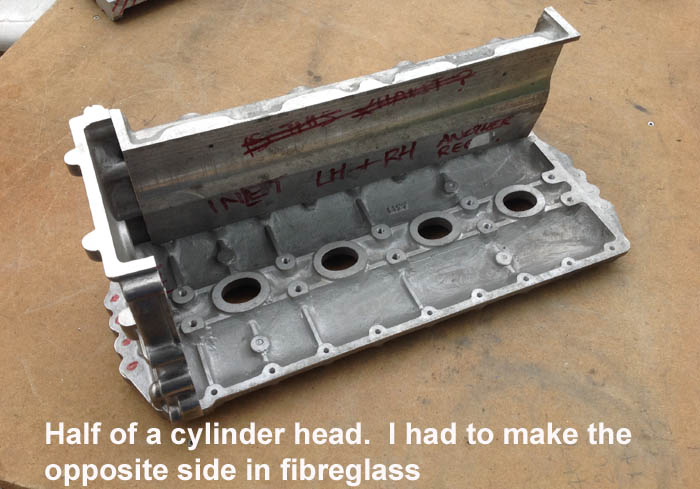
All this took place not long after we started restoring some of the parts of the car that eventually went to the Film Show described in part one of this story. The lumps of aluminium that were intended to be made into a replica DFV engine were put in a box and ignored until after the Film Show the following May. I have a clear memory of Peter, in the early summer of 2015, setting up a bench outside the sheds at the bottom of his garden and laying out all the pieces of aluminium that I had collected the previous year. It was only then that we realised that we didn't have all the pieces that were needed to make up a complete engine. We had several extra bits that were repeats, but two major, vital sections were missing. However, this disaster proved to be no more than a temporary inconvenience.....
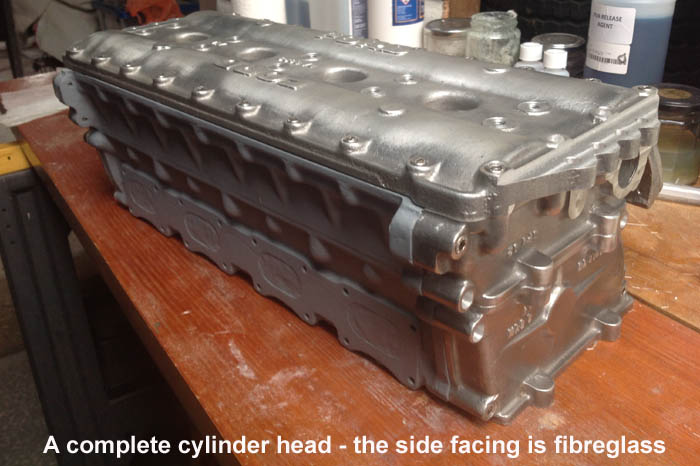 I hadn't even touched a piece of fibreglass since I made the airbox for the car forty-three years earlier, but Peter reminded me about something he had said many years before, that there is nothing magic in the world and with effort and application, anyone can do anything. Not totally true, of course, but it had certainly carried us along all those years before when people said that you can't build an F.1 car in a tiny lock-up garage. Fortunately, the fact that we had one of each of the two missing pieces and because the two halves of the engine are basically identical, I set out to make fibreglass replicas to take the place of the missing pieces. I have to admit to a couple of failures but eventually we had everything we needed to build up the two separate cylinder blocks of the engine.
Peter Connew is a man who insists that if something is going to be done, it's going to be done properly. Hence, wherever two pieces of the aluminium casting were to be joined together, the surfaces were milled perfectly flat and holes were drilled and tapped with a suitable thread, and stainless steel screws were always used to hold things together. It was a moment of immense satisfaction when my two fibreglass sections were bolted onto the aluminium boxes that made up the two separate cylinder heads, one of which you can see in the attached photo.
 The injection trumpets that sit atop of a DFV engine are made in spun aluminium. They are available, at a price, around £400 for a set of eight, but the ever resourceful Mr. Connew was able to obtain a set by another method entirely. He had them 3D printed. A good friend of mine in Malta, Joe Duca, knew of a place on the island who could electro-plate plastic to make it look like shiny chrome or polished aluminium. I took the eight trumpets over to Malta, on one of my regular visits, smoothed down the surface of the trumpets on Joe's lathe and left them with him to get them plated. He was so disappointed when, a few weeks later, I picked them up from him at Heathrow Airport because the plating process had roughed up the surface of the plastic and although shiny, our trumpets weren't usable. No matter; I sanded them down again and sprayed them with aluminium paint.
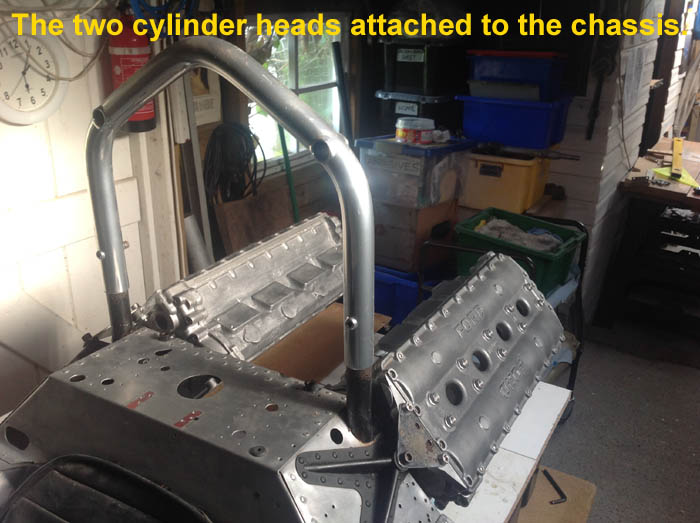 The time had arrived when the cylinder head 'boxes' needed to be attached to the chassis. Peter had informed me, months earlier, that an aluminium casting usually shrunk by about 1.5% as the aluminium cooled. This meant that if we joined together all the pieces we had, to create an engine, it probably wouldn't mate up to the mounting points on the chassis, of which there are four - two at the top and two at the bottom. Realising this, we approached the task of mounting the engine in a different way. As the two cylinder head sections were not attached to anything yet, we were able to bolt them to the chassis separately from one another.
Once this was done we were able to introduce the centre section that would eventually join with the two cylinder heads and thus, we could see that indeed, the three pieces would not quite line up. The solution was simple. We cut two rectangles of mdf and used them as packing pieces to bring everything into the correct position. 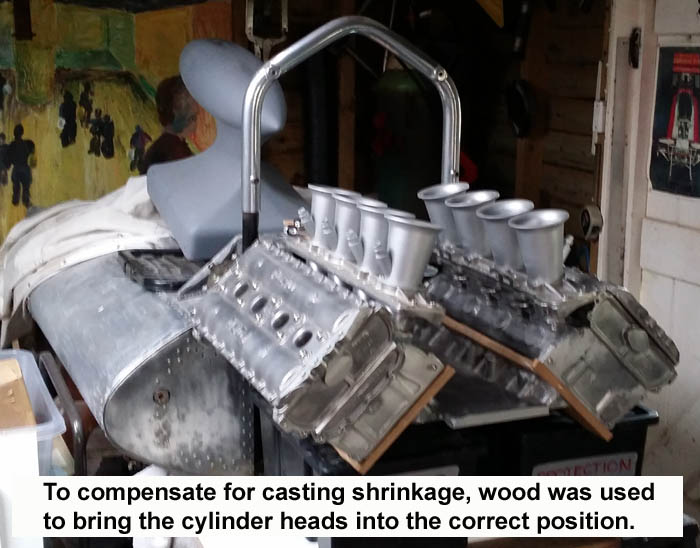 Once these were carefully trimmed to match the metal parts and painted silver it would only be a very keen eye that would spot their presence. With the pieces that would hold the throttle slides on a real engine bolted in place, we were able to put the sprayed injection trumpets in place. At this point we were beginning to feel that we were really moving forward and although there was still a huge amount of work to do, looking back to where we began gave us great satisfaction.
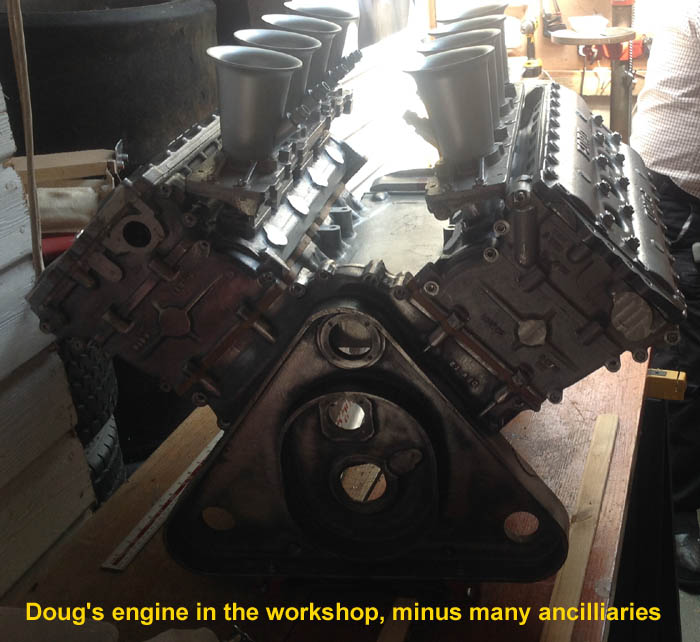 Going back to 1971, the very first appearance of the Connew in any magazine happened when racing journalist and author Doug Nye came along to the workshop in Chadwell Heath and produced an article about the team for Autosport. It would seem that Doug retained a soft spot for the Connew through the years and it must have been around Christmas time in 2016 that I contacted Doug. He has been a major part of the organisation of the Goodwood Festival of Speed since it began. I jokingly suggested that I thought it might be nice if, when the Connew was restored, we could take it down to Goodwood for that event - at some time in the future. Doug was so enthusiastic about that idea that I was rather taken aback. I knew that we had a huge amount of work to do if we were ever going to reach that stage and I guess I told him about our efforts to turn a large number of aluminium castings into a reasonable replica of a DFV engine. I was staggered when Doug announced that he actually owned a DFV engine - a non-working one - and if we cared to go down to his home in Surrey, we could borrow it.
This was a sensational development because Peter had obtained a working Hewland DG.300 gearbox and with a real engine we were more than three quarters of the way to having the car back on four wheels. I think it was a Sunday, early in 2017 when we drove down to Doug's, with Peter's son Chris with us to provide the muscle and soon after, there was a real DFV engine, sitting on the floor of the Connew lounge. Unfortunately, Doug's engine was almost totally lacking in all the extra components that a working engine requires; pumps, exhausts, trumpets, electronic transistor box etc etc etc. When we built the car we had an immense amount of help from many people and so it proved all over again as various companies or individuals bent over backwards to help move the project forward - particularly Hall & Hall, Geoff Richardson Engines, Connaught Engineering and the splendid Frank Lyons who lent us a couple of sets of DFV exhaust pipes.
Much time has passed since the events detailed above occurred and now, February 2021, we still have Doug's engine although it will go back soon, and I have to admit that the dummy engine made from Filching Manor's aluminium castings has been ignored for five years. But I know that Peter intends to finish it, one day.
Return to the racing images page or move on to the the next part of the story of the rebuild.